

Through Ash and Algorithm: Resistance, Reverence and Radical Ecology in Global South Cinema
Through Ash and Algorithm: Resistance, Reverence and Radical Ecology in Global South Cinema
I. Cinematic Offerings from the Rubble
There are memories that hum more than they speak. Mine start at the edge of sleep; half-formed chants and light leaks from distant screens. No collapsing buildings, but still, things fell. Language. Trust. The promise of representation. These ruins, scattered across digital and psychic terrain, are where my own cinematic hunger formed.
So I came to the films.
Recently, that hunger returned with force, ignited by a constellation of works:
- Put Your Soul on Your Hand and Walk (Sepideh Farsi & Fatima Hassouna, 2025) is built from hours of video calls between Iranian director Sepideh Farsi and Gazan photojournalist Fatem Hassouna. The film unfolds in fragmentary glimpses: clotheslines swaying in courtyards, friends laughing in cramped kitchens, rubble spilling into alleyways. It resists the sensationalist gaze of wartime media, mapping the daily rhythms of a woman navigating blockades, shortages, and the constant threat of airstrikes. Shortly after the film’s Cannes selection, Hassouna was killed in an Israeli missile strike, giving the footage the weight of a final testament.
- Who’s Afraid of Ideology? Part III: Microresistencias (Marwa Arsanios, 2020) is set in the mountainous heart of central Colombia. It follows a network of Indigenous women farmers who guard and exchange native seeds as an act of political defiance. Through patient observation, Arsanios records seed cleaning rituals, cooperative meetings, and quiet moments of teaching between elders and children. The women speak of resisting multinational agricultural corporations, paramilitary land grabs, and the monocultures that threaten both biodiversity and community autonomy. Arsanios interweaves these testimonies with her own reflections on ecofeminism, asking how cinema can both witness and participate in land defence.
- Nocturne I (Lata Mani & Nicolás Grandi, 2013) is a five-minute videopoem that takes place almost entirely in the stillness of night. It layers close-up, slow-moving images with a carefully composed soundscape of crickets, frogs, distant owl calls, and Bartók’s “The Night’s Music.” The telephoto lens pushes the viewer into and out of focus, letting light bleed and blur until shapes become abstract. The film has no conventional narrative, but the interplay of sound and image becomes its own tactile story. It’s a meditation on perception, fragility, and the spaces between what is seen and what is felt.
- Semiya (Seed Song) (Cecilia Vicuña, 2015) follows the Chilean poet and artist in the foothills of the Andes as she searches for endangered native seeds. Her hands sift pods, berries, and husks while her voice chants: “Sound is the seed of the universe.” The camera lingers on her touch, on water flowing over her palms, on the textures and colours of each seed variety. As she collects, she speaks of the knowledge encoded in these seeds, knowledge threatened by genetically modified agriculture and cultural erasure. The film operates as both an elegy for disappearing biodiversity and an invocation for collective stewardship.
Together, these works do not simply depict resistance. They practise it. They unearth underground threads of women’s ecology, militant care, ancestral revolt, and creative witnessing. What links them is not only their rootedness in Global South politics, but also their cultivation of cinema as a site of return: to soil, to voice, and to the circular logic of seed and archive. They demand a viewer who is not just present, but accountable.
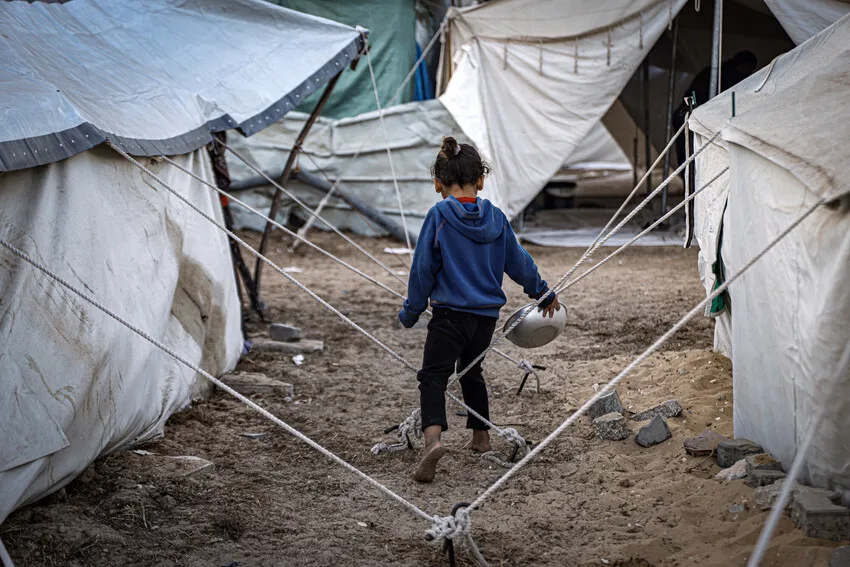
Everyday Gaza: fragments of ordinary life form the pulse of Sepideh Farsi and Fatima Hassouna’s Put Your Soul on Your Hand and Walk (2025).
II. Seeds Don’t Scream: Ecology as Weapon
“How do we inhabit the land?” asks Marwa Arsanios in her landmark film series Who’s Afraid of Ideology?.
In Microresistencias, she travels to Colombia and Lebanon to follow women’s collectives who merge agricultural care with political insurgency. In mountain villages, we watch them drying beans on cloths, passing seed-filled jars between hands, and debating planting strategies in communal gatherings. They speak directly about resisting seed patents and the monopolies of multinational corporations.
“When you are saving the seeds, you are nurturing, but you are also threatening seed corporations,” Arsanios says. “This is the resistance.” The garden becomes both a cradle and barricade.
This gendered martyrdom, caring for life while positioned at its frontlines, is rendered not as tragedy, but as assertion. The work of maintaining connection, whether through a camera lens, a shared seed jar, or a communal gathering, becomes inseparable from the act of bearing witness. In each case, preservation is not passive. It is an active form of resistance that records survival even as it is under threat. The women she films are not only tending the earth; they are rewriting the terms of survival under siege. Her camera becomes a vessel for unsettling colonial extractivism. She asks whether the same tool used to surveil can be repurposed to sow. Her answer lies not in rhetoric, but in practice: it depends entirely on how one films and for whom.
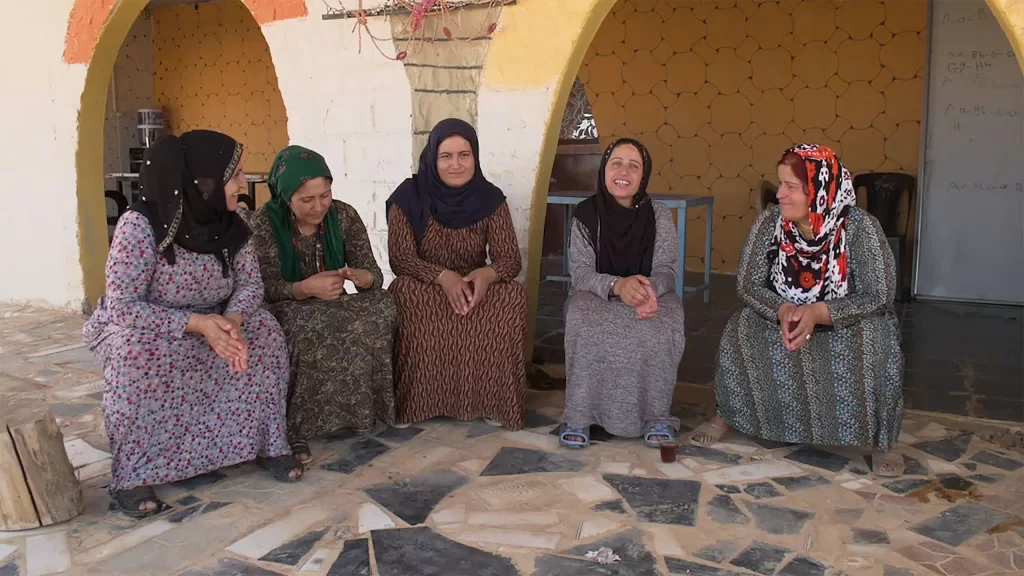
Seed as cradle and barricade: Indigenous women farmers in Colombia reclaim agriculture as political resistance in Marwa Arsanios’s Who is Afraid of Ideology ? Part IV, 2022 – HD Video – Video Still
III. Cousins of Conquest: Cinematic Kinships in Struggle
There is an undeniable kinship between Arsanios’s seeds and Fatem Hassouna’s lens in Put Your Soul on Your Hand and Walk.
In Put Your Soul on Your Hand and Walk, Sepideh Farsi constructs a film from the images Hassouna sent her before her death. This Gaza is not presented through the lens of breaking news. It is lived, textured, and stubbornly personal. The film honours not only the archive she left behind but the embodied risks of image-making.
The quiet power of the work is in how it resists spectacle. It offers no clean story arc, no sentimental cues. We see fragments: a girl skipping stones across still water, graffiti illuminated in morning light, books singed at the edges. These are scenes that the dominant media apparatus rarely deems worthy of preservation.
Hassouna’s camera bore witness long before Western news cycles paid attention. In Farsi’s hands, the resulting film becomes a posthumous duet. And in our watching, a trio.
As someone whose own lens was forged in the South African student protests of #FeesMustFall and #RhodesMustFall, I recognise this labour: the crafting of an archive while the structures you resist are actively trying to erase you. We are not children of the same war, but we are cousins of conquest, siblings in smoke.
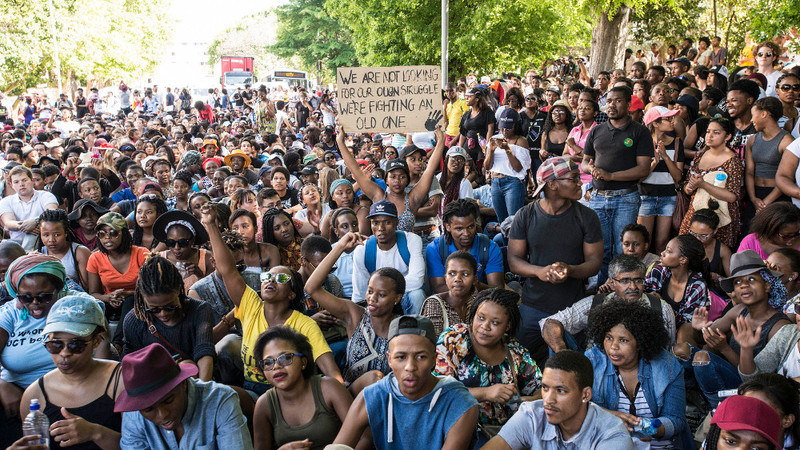
Pictured – #FeesMustFall Protestors, 2015. Sign: WE ARE NOT LOOKING FOR OUR OWN STRUGGLE, WE’RE FIGHTING AN OLD ONE
IV. Of Crickets and Comrades: Poetics of the Unseen
Emerging from the nocturnal soundscape of India’s sleeping cities, Nocturne I invites us to hear before we see. Crickets. Wind. The rustle of leaves. The distant hoot of an owl. Bartók’s “The Night’s Music” guides its structure. Here, silence is not absence but a density of memory.
Grandi’s telephoto lens operates within what he and Mani call the “circle of confusion,” where objects blur before becoming legible. In this play of sound and sight, they ask: what can only be seen in the dark?
The work rejects the auteurist hierarchy. Mani and Grandi call their process ensemble, a mode of collaboration where each element exists only in relation to the others. This method mirrors the feminist collectives that often underpin ecological struggles. The refusal to centre a single author becomes a refusal to accept extractive aesthetics. The film asks us to dwell, to unfocus, and to feel.
V. Singing Forward: A Network of Seeds and Screens
In Semiya, Cecilia Vicuña moves slowly through the foothills of the Chilean Andes, her voice carrying over the rustle of wind and the splash of a stream. She collects pods, berries, and husks, which are the tangible archives of a future threatened by monocultures, genetically modified crops, and trade systems that sever the link between Indigenous knowledge and land.
The film is both an elegy for ecosystems that are disappearing under the weight of industrial agriculture, and an invocation to recover and protect them. It is part of Vicuña’s decades-long practice of weaving Indigenous ecological memory into contemporary art, a practice rooted in both mourning and activation.
Placed alongside the other films, Semiya becomes a chorus. Each work resists through rhythm: political tempo, sonic reverence, and visual decay.
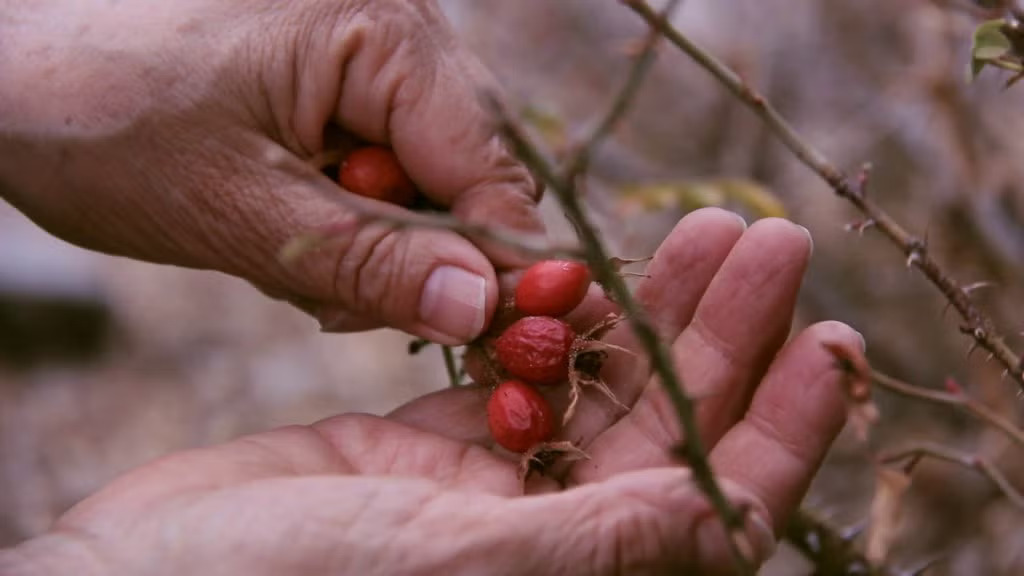
Pictured: Cecilia Vicuna’s hands holding pods and seeds in the Andes, from ‘Semiya’
VI. Tangible Engagement: How to Sow These Stories
For educators, curators, and community organisers, these films are not simply objects to be screened; they are tools to activate dialogue, community memory, and imaginative resistance.
Possible pathways for engagement:
- Discussion Questions
- How does each filmmaker define and practise “resistance” in their own context?
- In what ways do seeds, sounds, and moving images function as living archives?
- How do these films challenge the ethics and aesthetics of mainstream documentary?
- How does each filmmaker define and practise “resistance” in their own context?
- Screening Frameworks
- Pair Microresistencias with a local story of land defence or seed preservation.
- Follow Put Your Soul on Your Hand and Walk with a conversation on media suppression and the dangers faced by journalists. As background, educators might turn to Reporters Without Borders’ 2025 World Press Freedom Index for a global overview of shrinking press freedoms and methodology used to compile this data, to Committee to Protect Journalists’ reporting on Gaza for context specific to the film’s subject, and policy recommendations from thought leaders at Freedom House.
- Present Semiya alongside a seed-saving workshop or Indigenous-led ecological project.
- Pair Microresistencias with a local story of land defence or seed preservation.
- Creative Exercises
- Invite participants to create their own “microresistance” using accessible tools such as a short photo essay, an audio recording of a threatened soundscape, a community planting action, or a personal archive of recipes, songs, or seeds.
- Ask viewers to map the kinship lines between their own struggles and those depicted in the films.
- Invite participants to create their own “microresistance” using accessible tools such as a short photo essay, an audio recording of a threatened soundscape, a community planting action, or a personal archive of recipes, songs, or seeds.
- Further Viewing and Reading
- Farming (Alanis Obomsawin, 1975) for an intergenerational perspective on Indigenous agricultural resistance.
- Pelşîn Tolhidan writings (ecology & feminism): Mentioned in Arsanios’ interview, but we can reference through Atlantis Journal’s translated excerpts here
- Vandana Shiva on ecofeminism and seed sovereignty: The Law of the Seed
- Cross Pollination: Nicolas Grandi & Lata Mani – Group discussion with filmmakers hosted by creative practitioners on ‘Nocturne’.
In these films, sound and soil, archive and ash, loss and life all speak. Their makers do not ask for permission to be seen. They require that we listen differently, and that we translate that listening into action.
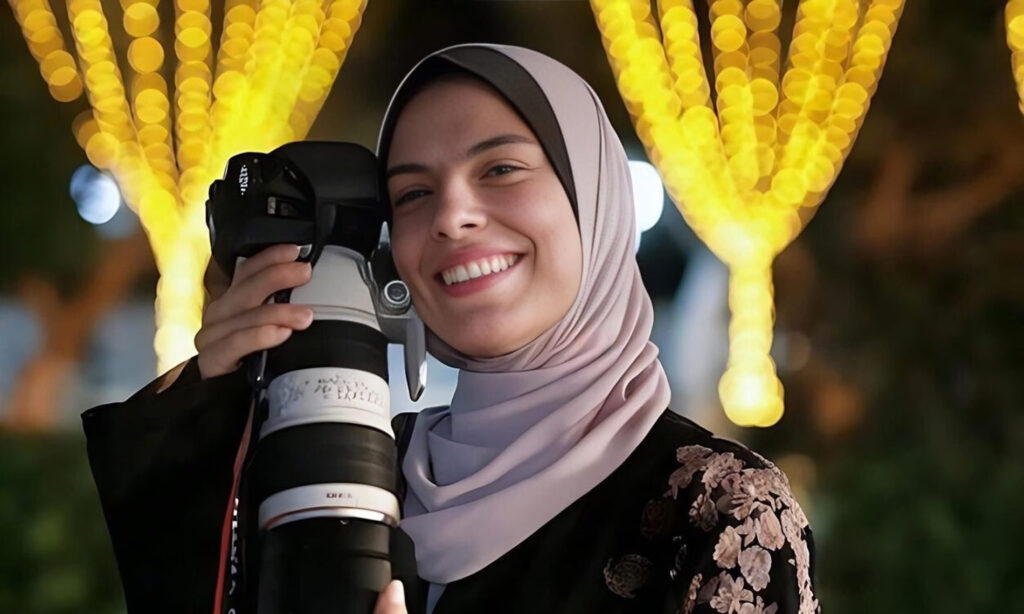
Pictured: ‘Put Your Soul on Your Hand and Walk’ Filmmaker Fatima Hassouna in Gaza
Contributor
A cultural consultant and writer, Maqhawe Junior Madonsela explores the intersections of media, history, and pedagogy. Their work spans film, education, and cultural strategy, crafting narratives that challenge dominant histories and amplify resistance. Whether designing curricula or dissecting archival footage, they blend research with lived experience to illuminate untold stories.